Fibromyalgia and Massage: Finding the Right Pressure for Your Body

Fibromyalgia can make the relationship between pain and pressure surprisingly complicated. Some people cannot tolerate much pressure at all, especially during a flare. Others describe something almost opposite: light touch feels irritating or unsatisfying, while slow, firm and sustained pressure feels deeply relieving.

Fibromyalgia

Over the years at LittleMum, we began noticing the second group. Some customers living with Fibromyalgia told us that they particularly liked the broad, sustained pressure of our body-weight massage tools. A few later recommended them to other people with Fibromyalgia, and we began hearing similar feedback again.

That caught my attention. Fibromyalgia is well known for increased pain sensitivity. So why would somebody with Fibromyalgia sometimes want firm pressure rather than avoid it? The answer may begin with an important distinction:

Pressure is not simply light or deep. How pressure is delivered matters. Slow pressure feels different from repeated pounding. Broad pressure feels different from one sharp point. Stable pressure feels different from rapidly changing pressure. And pressure you control yourself can feel very different from pressure somebody else controls for you.

Fibromyalgia does not necessarily mean massage has to be gentle. It means finding the right pressure for your body becomes especially important. Fibromyalgia pain is more than muscle pain. 

Fibromyalgia is a chronic condition involving widespread pain, commonly accompanied by fatigue, poor-quality sleep, cognitive symptoms and increased sensitivity to sensory input. Current rheumatology guidance describes altered pain processing as an important part of the condition rather than viewing Fibromyalgia simply as widespread damage or inflammation in the muscles. 

That does not mean the muscles do not matter. A person with Fibromyalgia still uses muscles, overloads muscles, develops local tenderness and can experience the same everyday muscular problems as anybody else.

Research has also identified active myofascial trigger points in people with Fibromyalgia. In one study, stimulation of multiple active trigger points reproduced substantial parts of participants' spontaneous pain patterns. 

The important point is not that trigger points “cause Fibromyalgia.” It is that Fibromyalgia and local muscular pain can exist at the same time. This creates a meaningful role for massage.

Massage does not have to treat the entire condition in order to be worthwhile. If it makes a painful muscular region more comfortable, reduces local tenderness, helps someone relax, or makes movement easier, that benefit still matters.

Massage really can help some people with Fibromyalgia

There is more evidence here than people sometimes realize. In a randomized controlled trial involving 74 people with Fibromyalgia, a 20-week massage-myofascial release program improved several outcomes including pain, sleep and quality of life compared with sham treatment. Some benefits were still present one month after treatment, although many differences were no longer maintained at six months. 

A second randomized trial using a 20-week myofascial-release program found improvements in pain, physical function, tender-point measures and clinical severity.  A systematic review of massage therapy for Fibromyalgia also concluded that programs lasting at least five weeks showed beneficial immediate effects on pain, anxiety and depression, although studies differed considerably in technique and quality. 

More recent randomized research continues to find potential benefits from myofascial release for pain modulation and health status in Fibromyalgia, although it does not support the idea that one manual technique solves every painful area. 

So I do not think massage needs to be presented apologetically in Fibromyalgia. There is a reasonable evidence base for saying: Massage and myofascial techniques can be useful complementary approaches for some people with Fibromyalgia.

The more interesting question is how to make massage suit the individual. Pressure sensitivity does not mean everybody wants light massage People with Fibromyalgia, on average, show increased sensitivity to pressure. Laboratory studies have repeatedly demonstrated lower pressure-pain thresholds and enhanced responses to painful stimulation compared with people without Fibromyalgia. 

But an average does not tell us what one particular person enjoys. And it certainly does not prove: “People with Fibromyalgia should only receive light massage.” That conclusion goes beyond the evidence.

Fibromyalgia is highly variable. One person may dislike firm pressure completely. Another may actively seek it out because a slow, steady pressure feels calming and satisfying. The same person can even respond differently from one day to another.

That is why I think the better question is: What type of pressure does my body respond to well today? Firm pressure and aggressive pressure are not the same thing.

This distinction is particularly important. Firm pressure can still be: slow, stable, broad, predictable, and easy to reduce. That is very different from repeatedly jabbing a painful point or using maximum body weight because “deep tissue has to hurt.”

A large, rounded contact distributing pressure across muscle creates a different sensory experience from a narrow hard point. A stationary pressure creates a different experience from rapid percussion. And lying quietly into pressure that you can reduce instantly is different from having someone else determine the intensity.

There is not currently good clinical evidence showing that one of these pressure qualities is specifically superior for Fibromyalgia. So I would not pretend that research has proven why some of our Fibromyalgia customers prefer LittleMum. But their experience raises a very reasonable practical idea:

The quality and controllability of pressure may matter just as much as whether we call that pressure light or firm. I think about a “pressure window”

For Fibromyalgia self-massage, I find it more useful to think in terms of a pressure window.

Below that window, the massage may feel insignificant, irritating or simply not satisfying. Above it, pressure may become overwhelming and provoke increasing pain.

Somewhere between those two is a range where the pressure feels substantial but still comfortable and useful. That range is personal. And it can move. On a good day, somebody may comfortably enjoy quite firm pressure. During a flare, exactly the same tool and exactly the same position may suddenly feel excessive.

That does not mean the massage has stopped working. It means today's pressure window is different. Instead of asking: “Should Fibromyalgia massage be light or deep?”

I would ask: “Where is my useful pressure window today?” That gives the person control back.

Tender does not automatically mean damaged

Fibromyalgia was historically associated with the familiar “18 tender points,” and earlier diagnostic criteria relied heavily on finding a certain number of painful locations under pressure.

Modern diagnostic approaches no longer require that tender-point examination. Fibromyalgia is now assessed much more broadly through widespread pain and symptom severity.  That change is useful for self-massage too. Someone with Fibromyalgia may be able to find many places that hurt when pressed. That does not mean every painful location is a muscle knot waiting to be released. Some areas may represent ordinary muscular overload. Some may contain meaningful trigger points. Some may simply be more pressure-sensitive because of the broader pain-processing changes associated with Fibromyalgia.

So the goal should not be: Find every painful point. The goal is: Find the areas where appropriate massage actually makes you feel better. That is a much healthier way to use pressure. 

Where the LittleMum Back Trigger Point Massager can fit

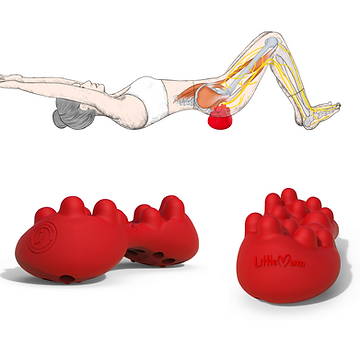
The LittleMum Back Trigger Point Massager was not designed as a treatment for Fibromyalgia. But its pressure style may explain why some customers with Fibromyalgia have responded so positively to it.

LittleMum Back Trigger Point Massager  for Fibromyalgia

The tool has a substantial silicone structure, while the rounded base allows small changes in body position to alter both location and intensity.  There is no motor. No vibration. No preset intensity. Your body creates the pressure. Your body also removes it.

For someone who enjoys firm, broad, sustained pressure, this provides something that is difficult to reproduce with the hands: several stable areas of contact across the back or gluteal muscles without continually gripping, pushing or rolling. And because the user controls body weight, the same tool does not have to deliver the same pressure every day. That flexibility is particularly relevant when symptom sensitivity changes.

Start with less body weight, not necessarily a softer tool

This is an important distinction. A person who enjoys firm massage does not necessarily need to buy a very soft massage tool on sensitive days. Sometimes it makes more sense to use the same stable contact but transfer less body weight into it.

The Back Trigger Point Massager can be used first on a bed or padded surface, where the contact is less intense than on a firm floor. Small changes in body position then allow the user to increase or decrease the pressure gradually. 

That makes the first question: “How little pressure do I need to begin feeling something useful?” rather than: “How much pressure can I tolerate?” 

The upper trapezius can be another important area

Many people with Fibromyalgia describe significant neck and shoulder discomfort in addition to more generalized body pain. When the upper trapezius itself feels locally tight or tender and responds well to pressure, the same principle applies: treat that local muscular problem without pretending you are treating Fibromyalgia as a whole.

The LittleMum Trapezius Trigger Point Massager uses several contoured contact points along both sides of the upper trapezius and is designed around slow, sustained body-weight pressure rather than powered kneading or vibration. 

Again, the useful part is not simply that the tool is firm. It is that pressure can be entered gradually and adjusted by the user. Someone who likes that sensation may find it very effective for their upper-trapezius discomfort. Someone who dislikes it does not need to be persuaded. The body has already answered the question.

I would be more selective with concentrated deep-tissue tools

Fibromyalgia does not automatically rule out deep tissue massage. Some people with Fibromyalgia genuinely love deep pressure. But the more concentrated the tool, the more important accurate positioning and pressure control become.

LittleMum's Deep Tissue tools deliberately create narrower and more concentrated contact than the broader Back Trigger Point Massager. That is useful when somebody has a specific muscular area that consistently responds well to focused pressure. 

I would not select them simply because: “Fibromyalgia hurts badly, therefore the massage needs to be deeper.” Pain severity is not a dosage instruction.

Instead, choose concentrated pressure because you already know that a particular muscular area responds well to concentrated pressure. That is a much better reason.

How I would try self-massage with Fibromyalgia

I would keep the first few sessions deliberately exploratory:

  1. Start below your expected pressure level. Use a padded surface or partial body weight first. Let the body settle before increasing anything.
  2. Choose one or two meaningful muscular areas rather than searching the whole body for painful points. The goal is relief, not identifying the greatest number of tender places.
  3. Stay with slow, stable pressure long enough to judge the response. There is no need to constantly roll or chase sensation.
  4. Notice what happens after the session as well as during it. If the body remains comfortable or feels easier later, that is useful information. If pain amplifies substantially, reduce the next dose.
  5. Let the pressure change from day to day. A good session does not create an obligation to reproduce exactly the same intensity tomorrow.

For Fibromyalgia, consistency does not have to mean identical pressure. It can mean consistently paying attention. A flare does not mean massage has failed. Fibromyalgia symptoms naturally fluctuate, so pressure that felt comfortable last week may feel excessive today. Reduce the pressure, shorten the session, choose another area—or skip massage that day. Self-care should adapt to the body rather than forcing the body to meet the routine.

Massage and exercise can play different roles

Exercise remains one of the best-supported long-term approaches for Fibromyalgia. The American College of Rheumatology recommends beginning gently and progressively, and EULAR's evidence-based recommendations gave exercise their strongest level of support among therapies reviewed. 

I do not think that diminishes massage. Exercise and massage can do different jobs. Exercise helps build physical capacity, fitness and tolerance over time. Massage may reduce muscular discomfort, help someone relax, make a painful region easier to move, or simply create a period during the day when the body feels more comfortable. Randomized trials and systematic reviews support a role for massage/myofascial therapy as a complementary intervention in at least some people with Fibromyalgia. 

For some people, feeling better after massage may even make movement and exercise easier to approach. There is no reason those strategies have to compete.

Do not blame every new pain on Fibromyalgia

There is one boundary I would keep firm. A person who has Fibromyalgia can still develop an ordinary injury, nerve problem, joint condition or another medical problem. New weakness, persistent numbness or tingling, substantial swelling, significant injury, fever, unexplained systemic symptoms or a distinctly new pattern of pain should not simply be labelled “another Fibromyalgia flare.”

A familiar muscular ache that consistently responds well to controlled pressure is one thing. A new neurological or unexplained symptom is another. Knowing the difference allows self-care to remain useful rather than becoming a reason to ignore something that deserves assessment.

There is no universal Fibromyalgia massage setting.  This is the idea I would like people to take away. Fibromyalgia does not mean: Your body is too sensitive for firm massage. And it does not mean: Deep pressure is what your muscles need.

Both statements are too simple. Some people with Fibromyalgia prefer very gentle massage. Some find slow, firm pressure deeply satisfying. Some change between the two depending on the day. The goal is not to use the strongest pressure you can tolerate, and it is not to stay unnecessarily light because somebody told you Fibromyalgia is “too sensitive” for firm massage.

The goal is to find: the pressure your body responds to well. That is what I mean by a pressure window. Why control matters so much.  This is ultimately the part of the LittleMum design philosophy that fits Fibromyalgia best.

For some of our customers living with Fibromyalgia, broad, sustained body-weight pressure has become an important part of their self-care routine.That does not make one LittleMum tool a treatment for Fibromyalgia. It tells us something more personal and perhaps more useful:

A body that experiences pain differently may also need the freedom to massage differently.

On one day, that may mean very little pressure. On another, it may mean the kind of firm, stable pressure that finally allows a tired muscle to feel comfortable. The person using the tool should be the one who decides.

References

  1. American College of Rheumatology. Fibromyalgia — Patient Information.
  2. Castro-Sánchez AM, et al. Benefits of Massage-Myofascial Release Therapy on Pain, Anxiety, Quality of Sleep, Depression, and Quality of Life in Patients With Fibromyalgia. Evidence-Based Complementary and Alternative Medicine. 2011.
  3. Castro-Sánchez AM, et al. Effects of Myofascial Release Techniques on Pain, Physical Function, and Postural Stability in Patients With Fibromyalgia: A Randomized Controlled Trial. Clinical Rehabilitation. 2011.
  4. Yuan SLK, et al. Effectiveness of Different Styles of Massage Therapy in Fibromyalgia: A Systematic Review and Meta-Analysis. Manual Therapy. 2015.
  5. Schulze NBB, et al. The Effect of Myofascial Release of the Physiological Chains on Pain and Health Status in Fibromyalgia. 2024.
  6. Sörensen J, et al. Hyperexcitability in Fibromyalgia. Scandinavian Journal of Rheumatology. 1998.
  7. de la Coba P, et al. Responses to Slowly Repeated Evoked Pain Stimuli in Fibromyalgia Patients. Pain Medicine. 2017.
  8. Alonso-Blanco C, et al. Multiple Active Myofascial Trigger Points Reproduce the Overall Spontaneous Pain Pattern in Women With Fibromyalgia. Pain Medicine. 2011.
  9. Macfarlane GJ, et al. EULAR Revised Recommendations for the Management of Fibromyalgia. Annals of the Rheumatic Diseases. 2017.
Back to blog

2 comments

Are there different sizes ?
I imagine pressure points are on a different place in a person 190 cm versus 163 cm ?

Linda

Are there different sizes ?
I imagine pressure points are on a different place in a person 190 cm versus 163 cm ?

Linda

Leave a comment